05.08.2026
$250000
InfraVeritas
47
The RWA market is growing on trust in paper. We are replacing it with cryptographic proof of the physical state of the asset. IPAS v1.0 standard,USPTO patent 63/876,031, working ZK prototype,
Project summary
Problem
The tokenization of real assets has moved out of the experimental phase: the volume of tokenized RWA on public blockchains reached approximately $31 billion as of July 2026 — more than 400% growth since the beginning of 2025.
But the growth is uneven. Capital goes where the proof of the asset is trivial: Treasuries, gold, private credit. Real estate, energy, infrastructure, raw materials — the segments with the greatest potential capacity — are left behind. The reason is one: between the physical object and the token stands a paper report and trust in the issuer.
This is the problem of the physical oracle. The smart contract perfectly executes the logic of income distribution, but it does not know whether the building exists, whether the station is actually working, whether the object is not mortgaged a second time. All cryptographic guarantees end where reality begins - and that is where the investor's risk is concentrated.
The result is visible in the data: most large tokenized assets show no movement on a weekly horizon, and DeFi actually involves about 10% of the total RWA value. Token issued — no liquidity. The market does not give a price to what it cannot verify.
Decision
InfraVeritas closes the gap between a physical object and its digital representation.
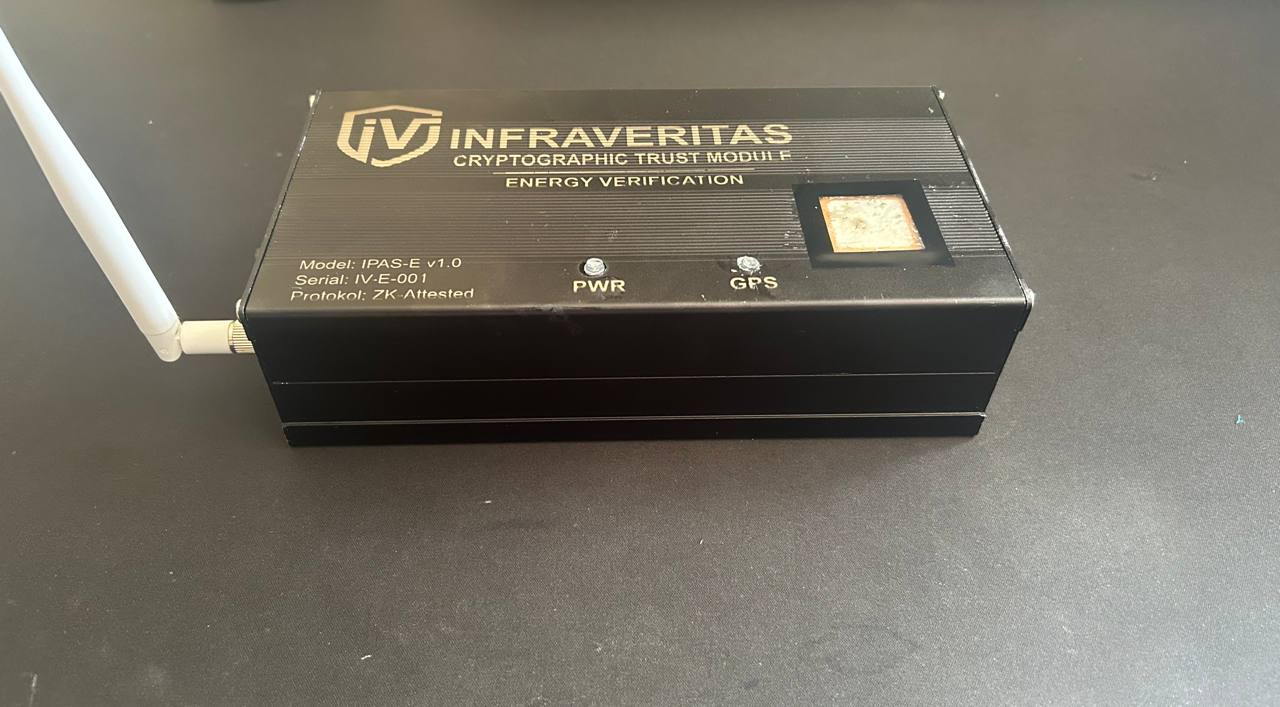
We build a hardware-cryptographic loop in which the asset’s state is captured by a certified measurement node directly on the object and transmitted to the blockchain along with a zero-disclosure proof. The proof mathematically confirms that the data traveled from the device to the smart contract without modification — while keeping the commercially sensitive metrics themselves undisclosed.
For the investor, the difference is fundamental: instead of "the issuer reports that the facility produces X" - "it is proven that the device on the facility recorded X, and this value was not edited along the way."
What has already been done?
- IPAS Standard v1.0 is an industry standard for physical asset verification, developed as the methodological basis of the protocol. Covers energy, real estate, agribusiness, oil and gas, and commodities.
- Patent protection — USPTO Provisional Patent #63/876,031.
- A working cryptographic circuit — the ZK scheme on Noir is compiled and generates valid proofs; the Solidity verification contract is generated; deployment on the testnet is prepared.
- Hardware platform — the configuration of the measuring unit has been determined, the design of an industrial housing (aluminum, DIN rail, industrial connectors) has been developed for installation in cabinets at the facility.
- Validation of the methodology on real transactions — technical due diligence was performed on existing tokenized offerings of European and Asian platforms. Critical discrepancies were identified that are not present in marketing packages: legal mechanisms affecting collateral, zoning restrictions, multi-year SPV unprofitability. The methodology received the first commercial response from a European platform.
- Industry position - a dialogue is underway with standardization and auditing organizations in the sector, working contacts have been established with specialized platforms.
Why this team?
The project was born not from the crypto industry, but from engineering.
The founder is a design engineer with a valid CC3 qualification certificate and over 25 years of practice: 157+ verified objects, 27 full-cycle design projects of sole authorship. A rare combination: a person who knows from practice how an object inspection is actually carried out and at what stage data substitution occurs, builds a cryptographic protocol that makes this substitution impossible.
The Web3 development and security direction is led by a co-founder with expertise in smart contract auditing.
Most RWA protocols are designed by people who have never signed an inspection report. We come at it from the opposite side.
12-month plan
- Deployment of contracts on the test network and full external audit of the ZK scheme and smart contracts.
- Production of a pilot batch of industrial-scale measuring units.
- Pilot implementation on a real object — a full cycle from sensor to token.
- Conversion of a provisional patent application into a full one (US + PCT). The deadline is strict — 12 months from the priority date.
- Integration with at least one tokenization platform as an external verification layer.
Use of funds
| Article | Sum |
|---|---|
| Engineering team (ZK, contracts, embedded software, backend), 12 months | $115,000 |
| External security audit of ZK-scheme and contracts | $35,000 |
| Equipment: pilot batch, housings, tests | $30,000 |
| Patenting: provisional conversion, PCT, attorney | $25,000 |
| On-site pilot implementation, installation, integration | $20,000 |
| Commercial development, industry events | $12,000 |
| Reserve | $13,000 |
| Together | $250,000 |
Who are we looking for?
An investor or industry partner who understands that a layer of trust is not an add-on to tokenization, but a prerequisite for it. The RWA market is not about liquidity or regulation, but about the inability to verify what is behind the token. We are building this verification